
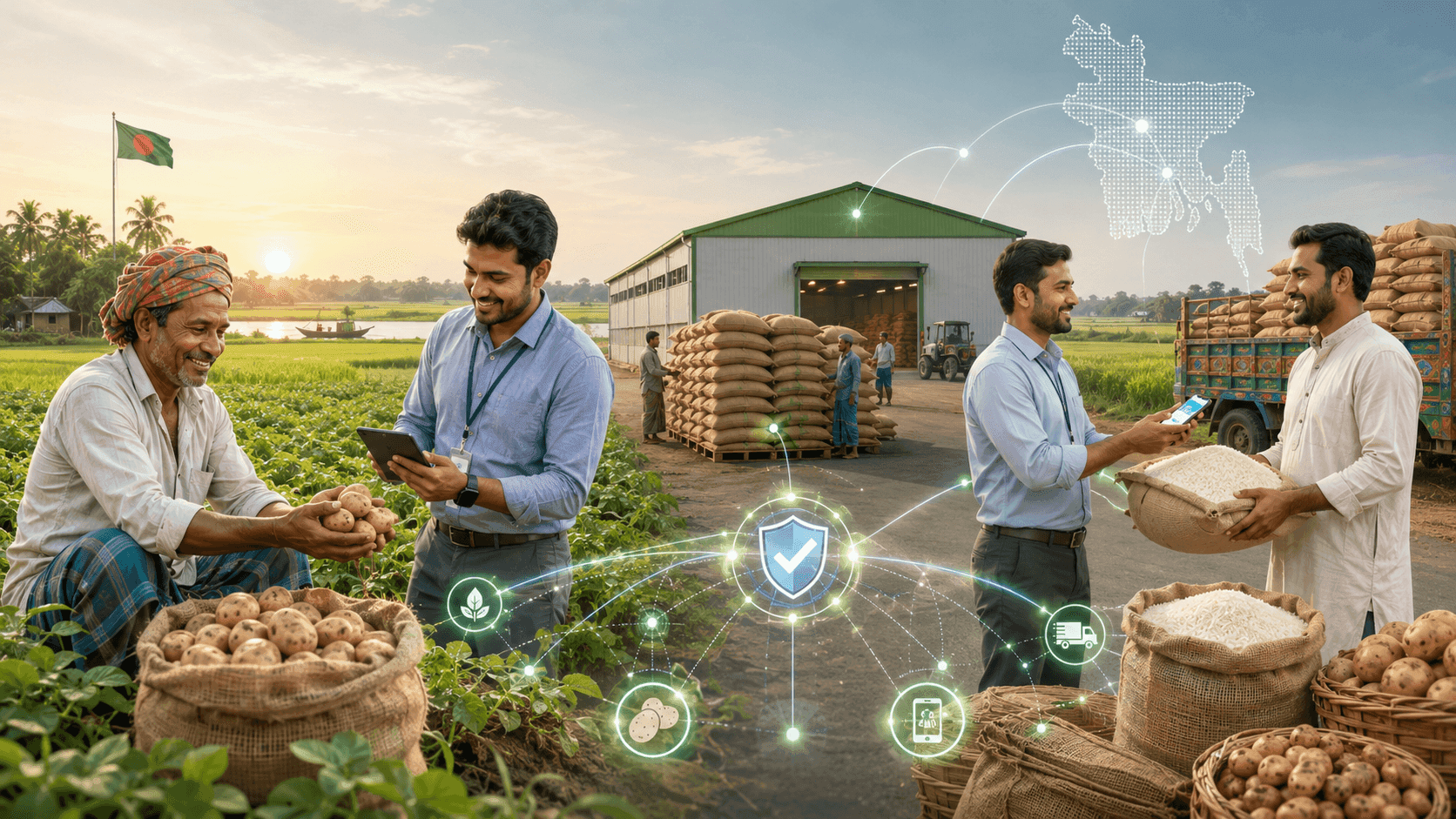
What Is CropsDex and How Does It Work?
Agricultural trade often involves several disconnected steps. A farmer needs to find a buyer, determine an appropriate price, verify product information, arrange transport, receive payment and sometimes store the commodity before it reaches the final buyer.
CropsDex brings these stages into a connected digital workflow.
In simple terms, CropsDex is a digital agricultural commodity trading and auction platform where a farmer can list produce, an assigned agent can assist with verification and listing preparation, an investor or commodity owner can purchase the product, the commodity can move to a designated warehouse and the owner can later offer it in an auction to buyers.
The process is supported by digital records and blockchain-based asset ownership records.
Who Participates in the CropsDex Ecosystem?
Five major roles are involved in the CropsDex process.
Farmer
The farmer lists agricultural produce for sale.
The listing may include the commodity name, quantity, expected price, production location, photographs and other relevant details.
CropsDex Agent
KSL may assign an agent to support the farmer.
The agent helps verify information, review product details, assist with photographs, provide pricing guidance and prepare the listing for approval.
Investor or Commodity Owner
An investor can purchase an approved commodity listing.
Once the required payment is received through KSL's designated payment process, the farmer and agent are notified.
The farmer receives the applicable payment and the agent receives the applicable commission according to the transaction process.
Warehouse
The purchased commodity is delivered to a designated warehouse.
The warehouse holds the physical commodity while the investor owns the corresponding commodity asset.
Warehouse information and a digital commodity certificate can then be made available to the owner.
Buyer
The commodity owner may later place the commodity in an auction.
Buyers submit bids.
After a winning bid is selected and payment is completed, the commodity can be released from the warehouse and ownership transferred from the investor to the buyer.
Step 1: The Farmer Creates a Listing
The CropsDex journey begins with the farmer.
The farmer provides information about the commodity being offered for sale.
A listing can include:
Commodity name
Variety or type
Quantity
Expected price
Production location
Current product condition
Photographs
Delivery-related information
The farmer does not necessarily need to prepare everything alone.
This is where the CropsDex Agent becomes important.
Step 2: The Agent Assists the Farmer
KSL may assign an agent to work with the farmer.
The agent helps verify and improve the information used in the listing.
This may include:
Checking commodity details
Helping take suitable photographs
Reviewing available quantity
Conducting an initial review of product quality
Correcting incomplete information
Providing pricing guidance based on relevant market conditions
Preparing the listing for approval
This creates a more structured listing for potential buyers or commodity owners.
Step 3: Listing Approval
After the required information has been collected and reviewed, the listing goes through an approval process.
Once approved, the commodity can become visible on CropsDex.
Potential investors or commodity buyers can then review it.
Step 4: The Investor Purchases the Commodity
When an investor decides to purchase a listed commodity, the investor completes the required payment process.
Once payment is confirmed, the relevant farmer and agent are notified.
The farmer receives the applicable commodity payment and the agent receives the applicable commission according to the settlement process.
Step 5: The Commodity Moves to a Warehouse
After settlement, the assigned agent supports the movement of the commodity from the farmer to the designated warehouse.
This is a major transition.
The commodity is no longer simply an online listing. It becomes a physical commodity held at a known storage location on behalf of its owner.
Relevant quantity, condition and receiving information can be recorded when the warehouse accepts the commodity.
Step 6: Digital Commodity Certificate
After warehouse receipt, the commodity owner can receive access to a digital commodity record or certificate.
Depending on the platform design, this record can include:
Commodity identity
Quantity
Warehouse
Owner information
Quality-related information
Transaction reference
Ownership history
Blockchain record
The purpose is to create a traceable relationship between the physical commodity and its digital ownership record.
Blockchain does not independently prove the physical quality of a commodity. Physical verification and digital recordkeeping are separate processes.
Step 7: The Owner Creates an Auction
The commodity owner may choose to offer the commodity for resale on a specific auction day.
A Floor Price or Reserve Price can be defined.
A Floor Price is the minimum price below which the owner generally does not intend to sell.
For example:
Floor Price: BDT 32 per kg
Buyer A: BDT 32.50
Buyer B: BDT 33.00
Buyer C: BDT 33.80
A winning bid is selected according to the applicable auction rules.
Step 8: The Winning Buyer Is Notified
After the auction is completed, the winning buyer receives a notification.
The buyer must complete the required payment within the applicable time.
Once payment is confirmed, the settlement and delivery process begins.
Step 9: A Buyer Agent Can Be Assigned
An agent may be assigned to assist the winning buyer with delivery.
The agent can help with:
Warehouse coordination
Delivery follow-up
Communication with the buyer
Supporting confirmation of successful handover
Step 10: Warehouse Transfer and Delivery
After payment confirmation, the warehouse can begin the release process.
The physical commodity is transferred according to the agreed delivery arrangement.
The buyer or the buyer's designated logistics arrangement receives the commodity.
Step 11: Digital Ownership Transfer
Alongside physical delivery, digital asset ownership can be transferred from the previous owner to the buyer.
This allows the transaction history of the commodity to remain traceable.
For example:
Farmer
then Commodity Owner
then Auction-Winning Buyer
The ownership chain can therefore be recorded digitally.
How Is CropsDex Different from a Simple Marketplace?
A conventional marketplace may allow a seller to upload a product and a buyer to purchase it directly.
The CropsDex model adds several additional layers.
These may include:
Agent-assisted verification
Structured commodity listings
Warehouse custody
Digital commodity certificates
Blockchain-based ownership records
Secondary auctions
Buyer bidding
Ownership transfer
Physical delivery support
For this reason, CropsDex is more than a basic agricultural listing website.
It aims to connect sourcing, ownership, storage, resale and delivery in one digital process.
Benefits for Farmers
Farmers can create structured listings.
They can receive assistance from an assigned agent.
They can receive support with photographs, information and pricing preparation.
Their commodity can become visible to potential investors or buyers.
Payment can be processed through a defined transaction flow.
Benefits for Commodity Owners
Commodity owners can purchase approved listings.
The commodity can be stored at a designated warehouse.
The owner can receive a digital ownership record.
The commodity may later be offered for resale through an auction.
However, agricultural commodity prices can rise or fall. Resale profit is not guaranteed.
Benefits for Buyers
Buyers can participate in auctions.
They can bid for warehouse-backed agricultural commodities.
They can receive digital transaction records.
They may also receive agent support during delivery.
The CropsDex Process in One Flow
Farmer
→ Agent Verification
→ Approved Listing
→ Investor Purchase
→ Payment Settlement
→ Warehouse Storage
→ Digital Commodity Certificate
→ Auction
→ Buyer Bidding
→ Winning Bid
→ Buyer Payment
→ Physical Delivery
→ Digital Ownership Transfer
Does CropsDex Remove All Trading Risk?
No.
Agricultural commodities can involve risks such as:
Price decline
Storage-related deterioration
Weight loss
Storage cost
Transport delay
Payment delay
Reduced buyer demand
Auction prices below expectations
Users should understand the applicable CropsDex terms, fees, risks and transaction rules before participating.
Conclusion
CropsDex connects several stages of agricultural commodity trading within one digital workflow.
A farmer lists a commodity.
An agent supports verification and listing preparation.
An investor purchases the commodity.
The commodity moves to a warehouse.
A digital commodity record is created.
The owner may later sell through an auction.
A buyer submits a winning bid.
Payment, physical delivery and digital ownership transfer complete the process.
Through this model, CropsDex aims to make agricultural commodity trading more structured, traceable and digitally connected.
Frequently Asked Questions
What is CropsDex?
CropsDex is a digital agricultural commodity trading and auction platform connecting farmers, agents, commodity owners, warehouses and buyers.
Can farmers create listings?
Farmers can initiate listings and may receive assistance from a CropsDex Agent with information, photographs, pricing and verification.
Where is a purchased commodity stored?
A purchased commodity can be transferred to a designated warehouse according to the CropsDex transaction process.
How can an owner resell a commodity?
The commodity owner may offer the commodity in an auction with a Floor Price. Buyers submit bids and a winning bid is selected according to the auction rules.
Why is blockchain used?
Blockchain can support digital ownership and transaction history records. Physical commodity verification remains a separate operational process.
Does CropsDex guarantee profits?
No commodity resale price or investment return should be considered guaranteed. Agricultural commodity prices and market conditions can change.
"CropsDex connects farmers, agents, commodity owners, warehouses and buyers through a structured agricultural trading process. Learn how a commodity moves from farmer listing to warehouse, auction and final delivery."
— Sayed Zubaer HasanIf you are a farmer, learn how to list your agricultural produce on CropsDex.
If you are a buyer or commodity owner, explore available commodity listings and upcoming auctions.